Elrond, Middle-earth’s Sweet Precious Cinnamon Roll to Good for this World

If there is any character in Tolkien’s Legendarium who needs a hug, it’s Elrond. This is a character who loses both parents, is raised by the two elves partially responsible for him losing his parents, loses his twin brother when Elros chooses to be counted as a Man, is separated for centuries from his wife when she sails West after being captured by orcs, and then loses his daughter when she makes the same choice as his brother. All of these reasons are why I feel like this towards Elrond:
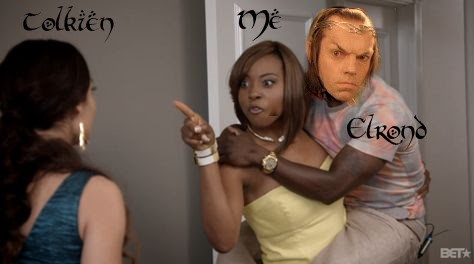
Seriously! For a good guy character, Elrond experiences far more misfortune than one would expect. And this is one of the reasons why I find him to be such a fascinating character. One of the many unanswered questions I have for Tolkien is why Elrond and Elros make the choice of kindreds that they did. We know that their father Eärendil wanted to be counted among Men but chose to be counted as an Elf for the sake of his wife Elwing, who chose the Elves since her grandmother Luthien had taken the choice of mortality. It’s a solid guess that their parents had no input into the twins’ choice of kindreds, since Eärendil was already enjoying his star-status and Elwing was living in her beach-house tower in Valinor, so what prompted their choices? Did Elros choose mortality for the sake of it being his father’s desired choice? Might have to revisit that question later.

I have wondered if part of the reason that Elrond chose the Elf-kindred was a desire or a hope that he would someday be reunited with them. He was five-ish years old when Maedhros and Maglor attacked the Havens in the Third Kinslaying, a terribly young age to suffer such as loss. Was it the longing for his parents that motivated him years later? Did the Elvish kindred seem to be the only choice that allowed him to see them again? If a reunion with his parents was what Elrond sought, I would argue that the Elvish kindred is the only choice he would feel safe making.

All the Elves know about the Gift of Men is that they go beyond the Circles of the World when they die. They don’t know what happens after that, and if Men will ever be seen again. If this fear of the unknown is behind Elrond’s choice, it makes sense. If he chooses the Elves, there is at least a chance that he will see his parents again. Who knows what will happen if he chooses Men?

The irony in Elrond choosing the Elves is that he ends up getting a good dose of humanity’s experience of death and loss. He sees his brother, his brother’s children, and then their children die. He sees his brother’s kingdom fall to ruin and evil before being destroyed. Jumping forward to the Third Age, Elrond loses his wife after Celebrian is captured by orcs, and by the end of The Lord of the Rings, he loses his daughter as well when Arwen chooses mortality and Aragorn. And since we know that Elrond became as a father to Aragorn after Arathorn’s death, he will eventually lose a son as well. Interestingly enough, Aragorn has almost the opposite of this problem- despite being mortal, because of his Numenorean ancestry, he outlives the majority of his friends. Case in point, it is technically possible that Boromir was at least born when Aragorn was finishing up his time as Thorongil. I’ve seen some great fanart depicting Echthelion with a tiddling Boromir and Thorongil somewhere, but this probability adds even more emotional turmoil to Boromir’s death at Amon Hen. Eomer, Faramir, Merry, and Pippin, Aragorn outlives them all and gets a taste of the Elvish experience of life through this.

But I have wandered from the path. It is because of his choices and losses that Elrond is somewhat of an enigma to me, a character who easily could have supplied enough story to fill of book of his own, and yet all the reader gets are tantalizing hints.

For all that The Rings of Power has, to put it nicely, caused discussion among the Tolkien community, one thing that I did enjoy about the first season was how they explored Elrond before he was “Lord Elrond”. True, it is speculation on their part, but it provided some fun rabbit holes to wander down. I am looking forward to Elrond in future seasons, though it is going to hurt knowing the griefs that still lie before him.
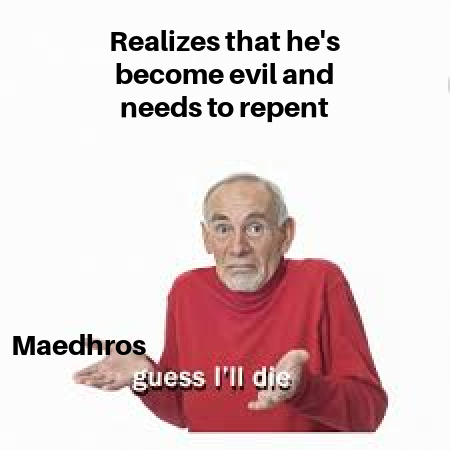
The Real Tragedy of Maedhros

Let’s get this out of the way first folks: all of the Feanorians commit atrocities over the course of the Silmarillion. I’m not going to waste space going into detail about each of the kinslaying and other crimes against elfmanity. Feanorian apologists can stan them as much as they want, but to paraphrase Jane Austen, it is a truth universally acknowledged that committing genocide is never justifiable, no matter if you’ve sworn an oath invoking the name of Iluvatar or no.

Which brings me back to Maedhros. Unlike the three Cs (Celegorm, Curufin, and Caranthir), and the Ambarussa (who get very little narrative attention to begin with), he and his brother Maglor are treated as noble, if tragic, figures who must endure the consequences of their mistakes while still fighting the good fight against Morgoth. What I’m going to argue here is that Maedhros is a little more complicated than that. He is the hero fallen, on a journey from the pedestal to perdition.

It’s easy to understand why Feanor and his sons swore their Oath at first; they have been grievously wronged by Morgoth and the social mores Tolkien uses carry the expectation of avenging any wrongs inflicted upon you. It is part of maintaining personal honor, but Maedhros and his brothers take this belief to extremes. They become totally committed to the mindset that the ends justify the means. I’d imagine their thought processes would look something like this:

Oh no, I’ve killed another elf who had absolutely nothing to do with murdering my grandfather or stealing the Silmaril. But at least I’m upholding the Oath!

But at what cost? At what point does keeping your word become evil? How far is too far? This is what I believe the warning of Maedhros is: an illustration of what a fanatical adherence to this idea of honor brings about. The kinslayings offer a great example of this. The massacre at Alqualonde could be blamed on the Teleri “insulting” Feanor and perhaps even an implied threat of hinderance on the Teleri’s part. The second kinslaying is even easier to justify from the viewpoint that Dior had done nothing to A) earn the Silmaril as his parents did and B) had no claim of inheritance to it as the Feanorians did. But with the third kinslaying, the killing of Noldor against Noldor, there is no justification for the Feanorians’ actions here. What makes the third kinslaying so evil is that it is the slaying of members of the same kindred: Earendil and Maedhros are distant cousins. The remaining Feanorians are literally attacking their own family and their own people at this point, all in the name of fulfilling their oath. One of Feanor’s kin (his great-great half nephew to be exact) is technically holding a Silmaril. It’s a razor thin technicality, but it could be argued that since a Noldor relative of the Feanorians has custody of a Silmaril, the Oath is fulfilled.

Maedhros’s actions after the second kinslaying (trying to find Elured and Elurin) and the third kinslaying (kidnap/fostering Elrond and Elros) show that he is well aware of the evil of his actions, but he does not back down. True, the oath he took damns him to the everlasting darkness if he abandons it, but how can avoiding that fate be worth the amount of blood he has on his hands at this point? And even if by some miracle he does retrieve a Silmaril (yes, yes, I know), it isn’t as though he will be able to return to Valinor: I’m pretty sure that the sons of Feanor are at the top of the DO NOT LET IN list for Club Aman. So is it just fear of the everlasting darkness that keeps Maedhros going? Partly, but I think there is something else adding fuel to his fire: pride. It runs in the family- stubborn pride was what I believe lead a dying Feanor to make his sons swear to uphold the Oath even though he now knew they would fail. While Maedhros physically takes after his mother, he turns out to be more like his father than is at first apparent.

Now, I can see the Maedhros stans grabbing their pitchforks, but hold on a second and let me point you in the direction of what takes place after the War of Wrath.

Morgoth is defeated and no longer in possession of any of the Silmarils; the Host of Valinor now has custody of the remaining two. To their credit, Maedhros and Maglor are both weary and loathing the Oath, but they still have the chutzpah to demand that the Silmarils be returned to them, despite everything they have done. Eonwe refuses them and gives a counter-demand: return to Valinor to face judgement for their crimes against elfamanity. It isn’t an unjust request- Oath or no, these two brothers have committed genocide three times. Their victims deserve justice. Maglor wants to comply, pointing out that even if they are condemned to the Everlasting Darkness, at least no more innocent blood will be shed. This isn’t a good enough reason for Maedhros, who convinces his brother to give Operation Get A Hand On A Silmaril another good ol’ college try.

Just for humor’s sake, imagine the theme music from Mission Impossible playing on a rude harp as Maedhros and Maglor disguise themselves and sneak into Eonwe’s camp. They are literally thieves in the night. At this point, it doesn’t seem to matter how much blood is spilled, because they kill the guards before taking the Silmarils.

“But the jewel burned the hand of Maedhros in pain unbearable; and he perceived that it was as Eonwe had said, and that the oath was vain. And being in anguish and despair he cast himself into a gaping chasm filled with fire, and so ended; and the Silmaril that he bore was taken into the bosom of the Earth.” (305)

Because they were hallowed by Varda, the Silmarils permit no evil thing to touch them. They react the same way to Maedhros’ touch as they would to that of Morgoth or Sauron; understandably so, Maedhros is horrified to discover this. Even now, there is nothing that says his repentance would be rejected; Eonwe would not let the brothers be killed even after they killed the guards. Maedhros could return to the camp, return the Silmaril, and face the consequences of his actions. He doesn’t even have to return to Valinor; he could simply return the Silmaril and leave the rest of his serial longeval days in exile. Instead, Maedhros rejects repentance completely, just as Feanor had, in a defiant final act that takes the Silmaril down with him: if he can’t have it, then no one can.

I really am conflicted about Maedhros now. I want him to be the hero; he should be the hero. He isn’t. That is what the true tragedy of Maedhros is: wasted potential and what-should-have-beens sacrificed in the name of pride.

Works Cited

Tolkien, J.R.R. The Silmarillion

A tall glass of ginger

If I go back to 2012 when my love of Tolkien’s work really began, there is one very tall, pointy-eared red-headed figure who stands out as being responsible for why Middle-earth owns so much of my mental real estate now. My interest in Tolkien was re-ignited by the story of Beren and Luthien, but it was the character of Maedhros who really drew me in, thanks in part to a tongue-in-cheek Tumblr post I came across where someone had commented that Tolkien had named one of his elves “Hot Ginger”*.

Maedhros the Tall, eldest of the sons of Feanor, is one of the most popular characters that I have seen in the Tolkien fanfiction community and the fandom in general. I’d even be in the camp that says he is one of my favorite characters. The more I thought about just what it is about him that I liked (beside the red hair), I kept running into the issue of the treatment the character receives not matching their actions. Hear me out on this. If we look at Tolkien’s work, we see that the narrative treatment of heroes reflect their actions in the story, while the reverse is true of villains. The deeds and actions of the character are what decide their role. Morgoth is seen as the villain because he causes slaughter and mayhem, not necessarily in that order. Samwise is seen as a hero because of his selflessness and bravery on the quest to destroy the Ring. When we look at Maedhros however, there’s a bit of a paradox.

Let’s take a look at some of the defining actions of Maedhros’ life:

  • swears the Oath,
  • participates in all three kinslayings, the last of which was literally against his cousin’s family
  • kidnaps a certain set of Peredhel twins (does this make him Aragorn’s foster-grandfather-in-law?)
  •  rebels against the Valar one more time after the War of Wrath when he and his brother Maglor steal a Silmaril from the Valar’s camp.

Yet despite these atrocities, he is not seen or treated by either the narrator/Tolkien or the fandom as a villain. If anything, he is viewed as a tragedy, a cautionary tale and given sympathy. His behavior appears to be… gulp… excused.

What is it about this elf that causes this and what is it about Maedhros that makes him so popular among fans? Why does he receive such a light treatment, especially from fans, when it comes to his villainous actions? His brothers Celegorm and Curufin are reviled for their treatment of their cousin Finrod and Luthien, but Maedhros’ essentially orphaning Elrond and Elros is almost treated with an endearing sentiment in the form of #kidnapdads. Does it boil down to just his good looks? Or is there something about this not-quite-villain-but-definitely-not-a-hero character that speaks to something in us? I’d like to think it is the latter, that Maedhros-stans see him as a surprisingly modern character dealing with the reality that bad decisions can have permanent consequences, even when you try to repair them. But I’m still left questioning if this means we are left loving a villain and what exactly Tolkien was trying to say by creating such a character.

*Maedhros is a Sindarization of maed, “shapely” and ross, “red haired” which are the combination of his mother-name Maitimo “shapely-one” and Russandol “copper-top”

The Silmarillion, The Hobbit, and The Lord of the Rings are the property of the Tolkien Estate. All other views expressed are the author’s, who reserves all rights.