Let’s get this out of the way first folks: all of the Feanorians commit atrocities over the course of the Silmarillion. I’m not going to waste space going into detail about each of the kinslaying and other crimes against elfmanity. Feanorian apologists can stan them as much as they want, but to paraphrase Jane Austen, it is a truth universally acknowledged that committing genocide is never justifiable, no matter if you’ve sworn an oath invoking the name of Iluvatar or no.
Which brings me back to Maedhros. Unlike the three Cs (Celegorm, Curufin, and Caranthir), and the Ambarussa (who get very little narrative attention to begin with), he and his brother Maglor are treated as noble, if tragic, figures who must endure the consequences of their mistakes while still fighting the good fight against Morgoth. What I’m going to argue here is that Maedhros is a little more complicated than that. He is the hero fallen, on a journey from the pedestal to perdition.
It’s easy to understand why Feanor and his sons swore their Oath at first; they have been grievously wronged by Morgoth and the social mores Tolkien uses carry the expectation of avenging any wrongs inflicted upon you. It is part of maintaining personal honor, but Maedhros and his brothers take this belief to extremes. They become totally committed to the mindset that the ends justify the means. I’d imagine their thought processes would look something like this:
Oh no, I’ve killed another elf who had absolutely nothing to do with murdering my grandfather or stealing the Silmaril. But at least I’m upholding the Oath!
But at what cost? At what point does keeping your word become evil? How far is too far? This is what I believe the warning of Maedhros is: an illustration of what a fanatical adherence to this idea of honor brings about. The kinslayings offer a great example of this. The massacre at Alqualonde could be blamed on the Teleri “insulting” Feanor and perhaps even an implied threat of hinderance on the Teleri’s part. The second kinslaying is even easier to justify from the viewpoint that Dior had done nothing to A) earn the Silmaril as his parents did and B) had no claim of inheritance to it as the Feanorians did. But with the third kinslaying, the killing of Noldor against Noldor, there is no justification for the Feanorians’ actions here. What makes the third kinslaying so evil is that it is the slaying of members of the same kindred: Earendil and Maedhros are distant cousins. The remaining Feanorians are literally attacking their own family and their own people at this point, all in the name of fulfilling their oath. One of Feanor’s kin (his great-great half nephew to be exact) is technically holding a Silmaril. It’s a razor thin technicality, but it could be argued that since a Noldor relative of the Feanorians has custody of a Silmaril, the Oath is fulfilled.
Maedhros’s actions after the second kinslaying (trying to find Elured and Elurin) and the third kinslaying (kidnap/fostering Elrond and Elros) show that he is well aware of the evil of his actions, but he does not back down. True, the oath he took damns him to the everlasting darkness if he abandons it, but how can avoiding that fate be worth the amount of blood he has on his hands at this point? And even if by some miracle he does retrieve a Silmaril (yes, yes, I know), it isn’t as though he will be able to return to Valinor: I’m pretty sure that the sons of Feanor are at the top of the DO NOT LET IN list for Club Aman. So is it just fear of the everlasting darkness that keeps Maedhros going? Partly, but I think there is something else adding fuel to his fire: pride. It runs in the family- stubborn pride was what I believe lead a dying Feanor to make his sons swear to uphold the Oath even though he now knew they would fail. While Maedhros physically takes after his mother, he turns out to be more like his father than is at first apparent.
Now, I can see the Maedhros stans grabbing their pitchforks, but hold on a second and let me point you in the direction of what takes place after the War of Wrath.
Morgoth is defeated and no longer in possession of any of the Silmarils; the Host of Valinor now has custody of the remaining two. To their credit, Maedhros and Maglor are both weary and loathing the Oath, but they still have the chutzpah to demand that the Silmarils be returned to them, despite everything they have done. Eonwe refuses them and gives a counter-demand: return to Valinor to face judgement for their crimes against elfamanity. It isn’t an unjust request- Oath or no, these two brothers have committed genocide three times. Their victims deserve justice. Maglor wants to comply, pointing out that even if they are condemned to the Everlasting Darkness, at least no more innocent blood will be shed. This isn’t a good enough reason for Maedhros, who convinces his brother to give Operation Get A Hand On A Silmaril another good ol’ college try.
Just for humor’s sake, imagine the theme music from Mission Impossible playing on a rude harp as Maedhros and Maglor disguise themselves and sneak into Eonwe’s camp. They are literally thieves in the night. At this point, it doesn’t seem to matter how much blood is spilled, because they kill the guards before taking the Silmarils.
“But the jewel burned the hand of Maedhros in pain unbearable; and he perceived that it was as Eonwe had said, and that the oath was vain. And being in anguish and despair he cast himself into a gaping chasm filled with fire, and so ended; and the Silmaril that he bore was taken into the bosom of the Earth.” (305)
Because they were hallowed by Varda, the Silmarils permit no evil thing to touch them. They react the same way to Maedhros’ touch as they would to that of Morgoth or Sauron; understandably so, Maedhros is horrified to discover this. Even now, there is nothing that says his repentance would be rejected; Eonwe would not let the brothers be killed even after they killed the guards. Maedhros could return to the camp, return the Silmaril, and face the consequences of his actions. He doesn’t even have to return to Valinor; he could simply return the Silmaril and leave the rest of his serial longeval days in exile. Instead, Maedhros rejects repentance completely, just as Feanor had, in a defiant final act that takes the Silmaril down with him: if he can’t have it, then no one can.
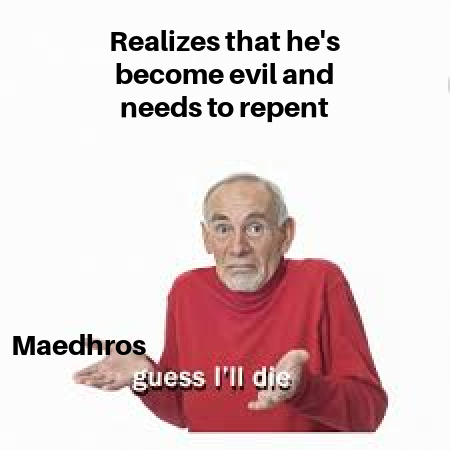
I really am conflicted about Maedhros now. I want him to be the hero; he should be the hero. He isn’t. That is what the true tragedy of Maedhros is: wasted potential and what-should-have-beens sacrificed in the name of pride.
Works Cited
Tolkien, J.R.R. The Silmarillion
 Rebecca Davis